Spend Smarter, Not Smaller: Why the Classic Cost-Per-Wear Rule Doesn't Work for Curvy Shoppers
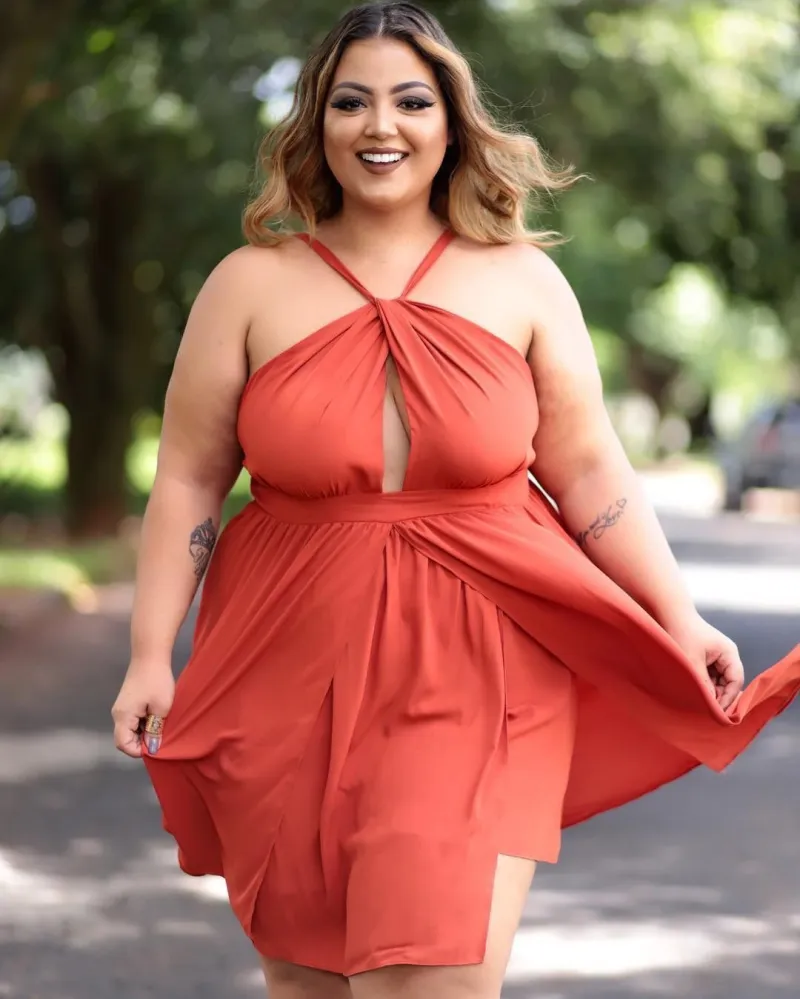
Photo: curvy plus size woman shopping for clothes trying on outfit in store, via i.pinimg.com
You've probably heard it a hundred times. Divide the price of a garment by how many times you'll wear it, and suddenly that $200 blazer makes total sense. The cost-per-wear formula has been the cornerstone of "smart" fashion advice for decades — a tidy little equation that makes splurging feel responsible and bargain-hunting feel strategic.
Here's the problem: that formula was designed for a shopping experience that most curvy women simply don't have.
When the baseline assumption is that you can walk into any store, find something in your size, and choose from a full range of styles and price points, cost-per-wear works fine. But when your size is stocked in exactly two colorways, the extended sizes sell out before the sale hits, and half the "investment pieces" that get recommended to you aren't even made past a size 16 — the math stops adding up. Literally.
The Hidden Tax on Curvy Fashion
Let's talk about something the fashion press rarely acknowledges: the curvy size premium. Study after study — and frankly, any plus-size shopper's receipts — confirms that extended sizes often cost more. Sometimes it's $5 to $10 more per item, sometimes it's a full tier of pricing. And it's not because more fabric costs significantly more to produce at scale. It's a market inefficiency that curvy shoppers have been absorbing quietly for years.
Layered on top of that is the availability gap. When your options are narrower, you don't get to comparison shop the way straight-size shoppers do. You find something that fits beautifully, flatters your shape, and comes in a color you actually like — and you buy it, because you know from experience that passing on it means it might not be there next week. That urgency isn't irrational. It's a survival skill born from scarcity.
So right away, cost-per-wear breaks down. You're not always choosing between a $40 option and a $120 option. Sometimes you're choosing between the $120 option and nothing.
When "Wear It More" Becomes Its Own Problem
The traditional formula also carries a subtle guilt trap. If you spend $150 on a dress and only wear it three times, the logic says you made a bad investment. But what if that dress fit you perfectly for a specific season of life, looked incredible at those three events, and made you feel genuinely confident? What's the cost-per-joy calculation?
More importantly: what happens when curvy women force themselves to keep wearing something that doesn't fit well anymore, just to justify the purchase? Poor fit is demoralizing. It affects how you carry yourself, how others perceive you, and how you feel walking into a room. Wearing a poorly fitting garment 30 times doesn't make it a good investment. It makes it 30 bad mornings.
For curvy shoppers, fit is not a luxury detail. It is the entire ballgame. And that changes the equation fundamentally.
Rewriting the Formula: What's Actually Worth the Splurge
So if cost-per-wear isn't the right metric, what is? Here's a more honest framework for curvy shoppers making investment decisions.
Fit quality over trend relevance. When a piece fits your actual body — not the idealized version of it, not "close enough with a belt" — it earns its price tag regardless of trend cycles. A well-cut pair of trousers that sits perfectly at your waist, moves with your hips, and doesn't gap at the back? That's a unicorn. Pay for it.
Fabric and construction matter more at your size. Cheap fabric lies differently on a curvy body. It clings where it shouldn't, bags where it shouldn't, and loses its shape after a handful of washes. Investing in quality fabric — particularly in structured pieces like blazers, trousers, and wrap dresses — pays dividends in how the garment performs over time. Think of it less like buying a trend and more like buying infrastructure.
Occasion-specific pieces have their own value. The idea that you should only invest in pieces you'll wear constantly ignores the reality that some garments are meant for specific contexts. A killer cocktail dress you wear four times a year is not a waste of money if it makes you feel like the most powerful person in the room every single time. Stop penalizing yourself for owning things that serve a purpose, even if that purpose is seasonal.
Alterations are part of the investment. This is the tip that straight-size fashion advice almost never gives, because it assumes things fit off the rack. For curvy women, building a relationship with a good tailor and factoring alteration costs into your clothing budget is genuinely transformative. A $60 dress that gets a $25 alteration and fits you like it was made for your body is a better investment than a $150 dress that almost fits.
The Wardrobe Strategy That Actually Serves You
Instead of chasing a universal cost-per-wear number, consider thinking about your wardrobe in three distinct investment tiers.
Anchor pieces are the things you reach for constantly — your everyday jeans, your go-to work trousers, your reliable wrap dress. These are worth spending more on, full stop. They carry the weight of your wardrobe and they need to fit impeccably.
Statement pieces are the ones that make you feel genuinely excited to get dressed. They might not come out every week, but their value is in the confidence they generate. Budget for these deliberately rather than guilt-spending on fast fashion alternatives that never quite deliver.
Experiment pieces are where you can be more flexible. Trends, new silhouettes, colors you're trying out — keep the stakes lower here. Shop sales, try rental services, or hit up brands with generous return policies.
The goal isn't to spend more overall. It's to spend intentionally — in a way that accounts for the actual reality of shopping as a curvy woman in America, where options are improving but still imperfect, where fit is hard-won, and where feeling good in your clothes is worth more than any spreadsheet formula can capture.
Give Yourself Permission to Do the Math Differently
The cost-per-wear rule wasn't written with you in mind. It was written for a shopping experience built around abundance and accessibility. You're navigating something more complicated, and you deserve a framework that respects that.
Spend on fit. Spend on fabric. Spend on the pieces that make you walk taller. And let go of the idea that your wardrobe choices need to be justified by a formula that was never designed for your body in the first place.